How to Get Your CDL in 2026: Step-by-Step Guide for Beginners
Thinking about becoming a truck driver? This beginner guide walks through the full CDL process in 2026, including permits, ELDT training, CDL school options, testing, costs, and what to expect before your first trucking job.
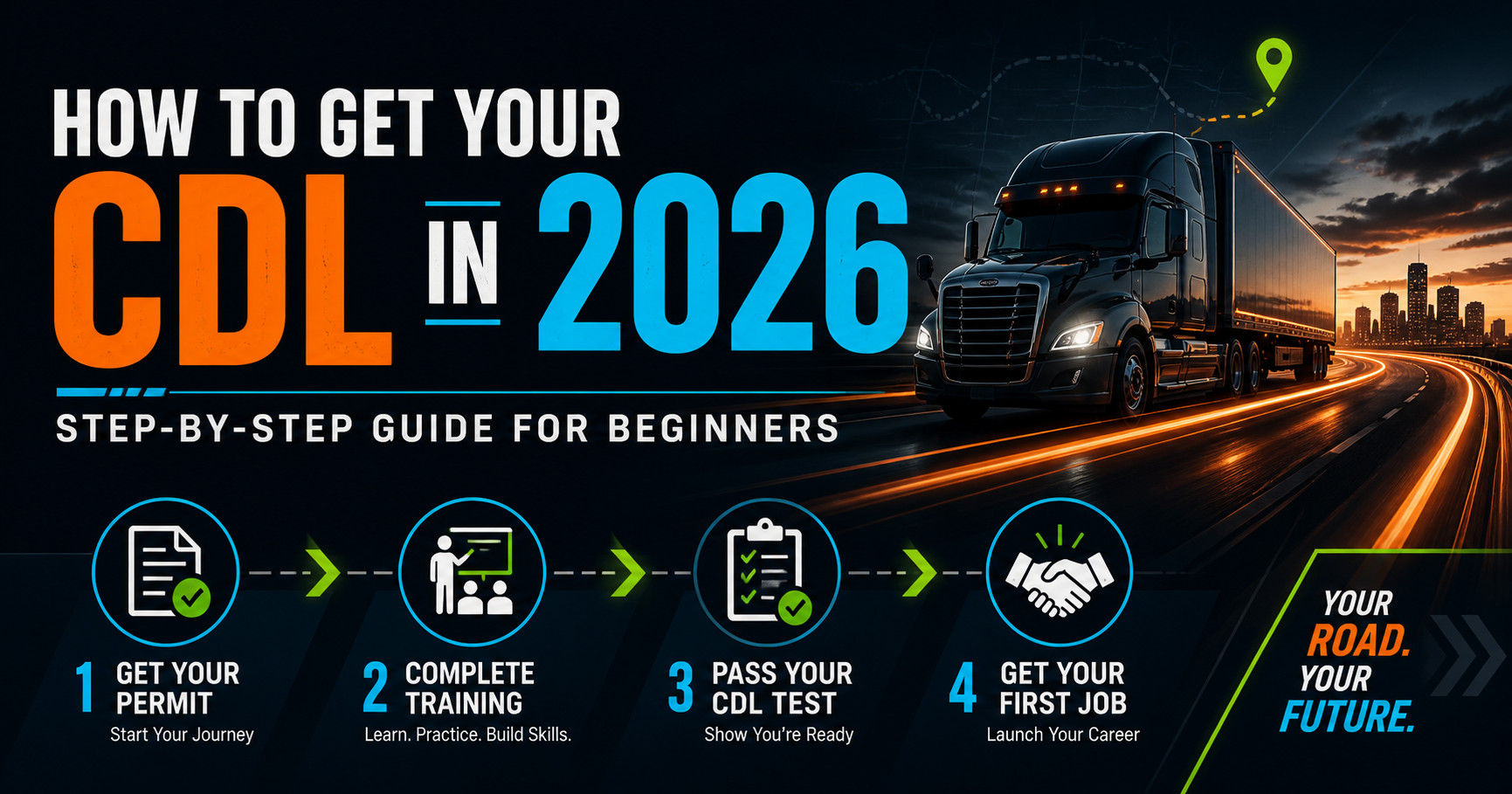
How to Get Your CDL in 2026: A Real Step-by-Step Guide for Beginners
So you're thinking about getting your CDL.
Maybe you've been looking at the pay, tired of your current job, or someone you know drives and made it sound decent. Whatever brought you here, welcome. I'm going to walk you through how this whole process actually works — not the sugar-coated recruiter version, but the real one.
Here's the good news: getting your CDL in 2026 is very doable. The process is straightforward once you understand the order of things. You don't need to figure it all out on day one. You just need to take it one step at a time and not let the noise online send you in circles.
Let's get into it.
What Is a CDL?
A CDL is a Commercial Driver's License. You need one to legally operate certain commercial vehicles — tractor-trailers, large straight trucks, buses, and vehicles hauling certain hazardous materials.
If your goal is to drive a semi, you're looking at a Class A CDL. That's the one that covers combination vehicles, meaning a truck hooked to a trailer. It gives you the most flexibility when it comes to job options.
There's also a Class B CDL, which covers straight trucks, dump trucks, box trucks, and buses. If you end up going that route, most of what I'm covering here still applies to you.
For most people reading this, Class A is the target.
Step 1: Be Honest With Yourself About the Lifestyle
Before you spend a dime or fill out a single form, take a breath and think about whether trucking actually fits your life right now.
I'm not trying to talk you out of it. I'm trying to save you from signing a contract, quitting your job, going through training, and then realizing three weeks in that you hate being away from home.
Ask yourself a few real questions:
- Can you handle being gone from home for days or weeks at a time if you go OTR?
- Are you okay starting over at the bottom and actually learning the job?
- Do you have a clean enough driving record to get hired?
- Can you pass a DOT physical?
- Are you the kind of person who stays calm when things don't go as planned?
You don't have to be perfect. Nobody walks into trucking perfect. But going in with honest expectations makes a huge difference in whether you stick with it or burn out in the first year.
Step 2: Make Sure You Meet the Basic Requirements
CDL requirements vary a little by state, but here's what most beginners should expect across the board:
- A valid regular driver's license
- Meet your state's age requirement
- Pass a DOT physical exam
- Provide identity and residency documents
- Pass the written knowledge tests for your Commercial Learner's Permit (CLP)
- Complete ELDT training (more on that in a minute)
- Hold your permit for the required time before taking the skills test
- Pass the CDL skills test
One thing worth knowing up front: if you want to drive across state lines — which covers most OTR and regional jobs — you generally need to be at least 21. Some states allow younger drivers to get a CDL for in-state driving only, but that limits your options pretty significantly when you start job hunting.
Step 3: Get Your DOT Medical Card
You'll need to pass a DOT physical before you can move forward. A certified medical examiner checks whether you're physically qualified to operate a commercial motor vehicle.
The exam typically includes:
- Vision check
- Hearing check
- Blood pressure
- Medical history review
- Basic physical
- Urine test for medical screening
If you pass, you'll get a DOT medical card. Keep it somewhere safe. You'll need it during the CDL process and your state may require it tied to your driving record.
Don't stress too much going in. Most people pass. Just be straightforward with the examiner about any medical history. Trying to hide something usually causes more problems than the condition itself.
Step 4: Study for Your Permit Test
Before you can get a full CDL, you need a Commercial Learner's Permit — your CLP. Getting it means passing a set of written knowledge tests.
For a Class A CDL, you'll typically need to cover:
- General knowledge
- Air brakes
- Combination vehicles
The air brakes section trips up a lot of beginners, so give it extra time. The combination vehicles section is more straightforward once you understand how a tractor-trailer system works.
Here's a study approach that actually works:
- Download your state's CDL manual (it's free)
- Read it section by section — don't try to swallow it whole
- Take practice tests after each section
- Review every wrong answer and figure out why it was wrong
- Keep going until you're passing practice tests consistently without guessing
The permit test isn't a trap. It's not trying to trick you. Study the material, take your time, and you'll be fine.
Step 5: Understand ELDT — This Is Important
ELDT stands for Entry-Level Driver Training, and if you're getting your CDL for the first time, this applies to you.
Since 2022, anyone getting a Class A or Class B CDL for the first time is required to complete ELDT through a provider registered on the FMCSA Training Provider Registry. This isn't optional and it's not something you can work around.
ELDT includes two main parts:
Theory training — Classroom or online instruction covering knowledge areas related to operating a commercial vehicle safely.
Behind-the-wheel training — Actual hands-on time. This includes range training (a big lot where you practice backing and maneuvering) and public road training.
The key thing to know: your training provider has to be properly registered with FMCSA, and they have to submit your completion before you can take your CDL skills test. If they drop the ball on that, it's your timeline that gets delayed. Ask about this before you commit to any school.
Step 6: Choose Your Training Path
This is where most beginners slow down, and honestly, it makes sense. There are a few different ways to get your CDL training and they each come with real trade-offs.
Option 1: Pay for CDL School Yourself
You pay tuition upfront — either out of pocket, through financing, grants, or workforce development programs.
The upside: You're not locked into any specific company when you finish. You have more freedom when job hunting.
The downside: It costs money. CDL school can run anywhere from a few thousand dollars to significantly more depending on where you go and what's included.
If you go this route, here's what to ask before signing up:
- Are they on the FMCSA Training Provider Registry?
- How much actual behind-the-wheel time do students get?
- What's the student-to-instructor ratio?
- What companies hire their graduates?
- What are all the fees, including ones not in the brochure?
- What happens if you fail the skills test the first time?
Not every school is worth the money. Some are solid programs. Others are just running students through as fast as possible. Ask the uncomfortable questions before you hand anything over.
Option 2: Company-Sponsored CDL Training
A trucking company covers or subsidizes your training costs in exchange for a work commitment — usually somewhere between 6 months and a year with their company after you finish.
The upside: You get trained and come out with a job already lined up. If money is tight, this is often how people make the CDL happen.
The downside: You're signing a contract. If you leave early, you may owe money back. The company chooses what you drive, where you go, and how you start.
That's not automatically a bad deal — plenty of people get their start this way and never regret it. Just go in with your eyes open.
Before you sign anything, get clear answers on:
- How long is the work commitment?
- What exactly happens if I leave before the term is up?
- What do I get paid during training?
- When does regular driver pay start?
- Will I be OTR, regional, or local?
- How long will I run with a trainer after hire?
- What comes out of my paycheck?
Read the contract yourself. Don't just go off what a recruiter tells you verbally. Recruiters aren't villains, but they have seats to fill — it's not their job to make sure you understand the fine print.
Step 7: Practice Like the Test Actually Matters
Passing the written test gets you the permit. It doesn't mean you're ready to drive a truck.
That's what training is for — and you need to take it seriously.
The CDL skills test has three parts:
Vehicle Inspection (Pre-Trip) You walk around the truck and explain what you're checking and why. This one catches a lot of beginners off guard because it feels like memorizing a script. Start learning it early. Walk around an actual truck if you can. Say it out loud until it sounds natural. Don't wait until the week before your test.
Basic Controls This covers backing and maneuvering — straight-line backing, offset backing, alley dock, sometimes parallel parking. These take repetition. The more time you get behind the wheel practicing, the better.
Road Test You drive in real traffic with an examiner. Lane changes, turns, railroad crossings, traffic management. This is where everything comes together.
Don't underestimate the pre-trip. It's the piece most beginners blow off, and it's one of the most straightforward parts to master if you just put the time in early.
Step 8: Take Your CDL Skills Test
Once your ELDT is complete, your permit has been held for the required time, and your provider has submitted the necessary paperwork — you're ready to test.
Test day is going to feel a little stressful. That's normal. You're operating a big vehicle with someone watching every move you make. Just do what you practiced.
A few things to keep in mind:
- Get decent sleep the night before
- Review your pre-trip that morning
- Know your air brake check cold
- Listen carefully to every instruction
- Don't rush
- If you make a mistake, reset and keep going — one error doesn't automatically mean failure
Panicking after a mistake is usually what turns one problem into three. Stay steady.
Step 9: Get Your First Job
Getting your CDL is the beginning, not the finish line.
Your first job is where you actually learn how trucking works — and there's a lot you won't fully understand until you're living it. Trip planning, dealing with shippers and receivers, managing your hours of service clock, backing into tight docks, driving in bad weather. That's all ahead of you.
Most new drivers start with beginner-friendly carriers, training fleets, or local and regional operations. If you go OTR, expect to spend time running with a trainer after you're hired. It can feel slow, but it's where the real education happens.
Your first year isn't about maximizing earnings. It's about becoming a safe, reliable driver with a clean record. That's what opens better doors later.
How Long Does It Take?
It depends on your path, but here's a realistic rough timeline:
Research and paperwork: 1–2 weeks DOT physical + permit studying: 1–3 weeks Permit testing: Varies by state CDL training program: 3–8 weeks Skills test scheduling: Varies by location Hiring and orientation: 1–3 weeks
Most people should plan for one to three months start to finish. Don't rush through training just to say you did it fast — the goal is to actually know what you're doing when you get out there.
How Much Does It Cost?
Costs to account for include:
- DOT physical
- State permit fees
- Study materials
- School tuition (if self-paying)
- Testing and endorsement fees
- Transportation and lodging during training
- Lost income if you leave your current job
Self-paid CDL school can run several thousand dollars. Company-sponsored training reduces the upfront cost but comes with a work commitment attached.
The better questions to ask aren't just "how much does it cost?" They're:
- What do I owe if I leave early?
- What gets deducted from my paycheck during training?
- What's realistic first-year income — not the best-case number?
- What happens if I fail a test?
Cheap upfront doesn't always mean cheap overall.
Mistakes Beginners Make
Not reading the contract. If a company sponsors your CDL, read every word. Don't rely on a recruiter's verbal summary.
Picking a school just because it's close. Convenience matters, but not more than training quality. Look at how much actual driving time students get.
Ignoring ELDT requirements. Make sure your provider is properly registered and on top of submitting your completion. If they're not, it's your test date that gets pushed.
Waiting to study pre-trip. Start it early. It's not hard — it just takes repetition.
Thinking the CDL means you know trucking. A CDL means you passed the test. Everything else comes with time on the road. Stay humble and keep learning.
The Basic Roadmap
- Research the lifestyle honestly
- Confirm you meet the basic requirements
- Get your DOT medical card
- Study and pass the permit test
- Complete ELDT with a registered provider
- Choose your training path — self-paid or company-sponsored
- Practice pre-trip, backing, and road driving
- Pass the CDL skills test
- Get hired with a company that supports new drivers
- Use your first year to build your skills and your record
That's it. Not complicated. Just steps.
Final Thoughts
Getting your CDL in 2026 is absolutely within reach if you follow the process and don't cut corners.
The hard part isn't really the test. It's making smart choices before you sign anything, picking a training path that fits your situation, and going into your first year with realistic expectations.
Take your time. Ask questions. Read the contract. Study the pre-trip. Be patient with yourself on backing — everyone struggles with it at first.
A CDL can be the start of a solid career. Plenty of people have built a good life in trucking. You just have to go through the process the right way.
Start with step one and keep moving.