How to Get Your CDL in 2026: Step-by-Step Guide for Beginners
Thinking about becoming a truck driver? This beginner guide walks through the full CDL process in 2026, including permits, ELDT training, CDL school options, testing, costs, and what to expect before your first trucking job.
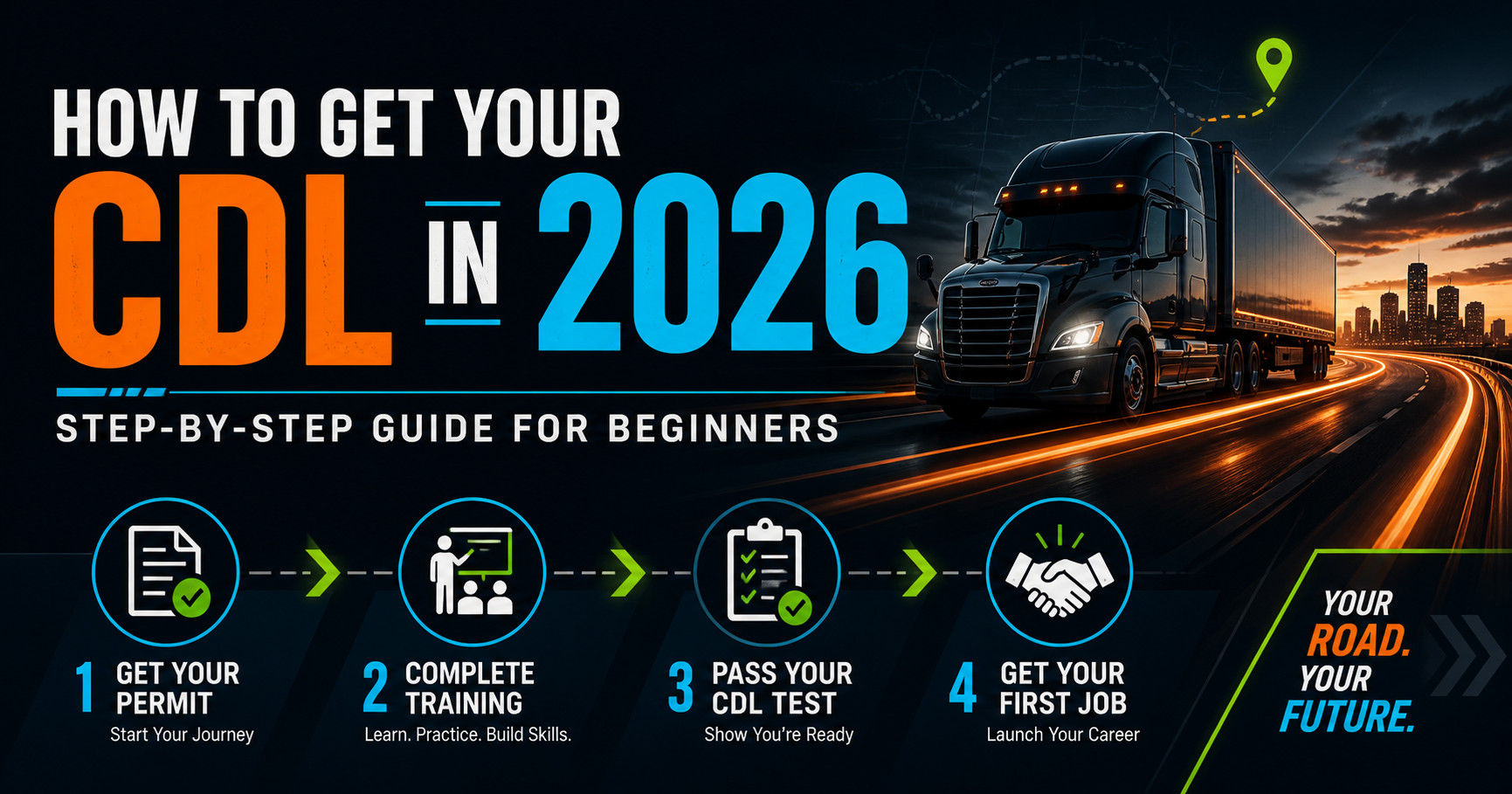
How to Get Your CDL in 2026: Step-by-Step Guide for Beginners
Getting your CDL can feel confusing when you first start looking into it.
You search one thing, then suddenly you are buried under CDL schools, company-sponsored training ads, permit tests, ELDT rules, endorsements, medical cards, recruiters, contracts, and people on the internet acting like every option is either perfect or a scam.
The truth is simpler than that.
Getting your CDL in 2026 is a step-by-step process. You do not need to know everything on day one. You just need to understand the order of the process, what each step is for, and where beginners usually get tripped up.
This guide breaks down the full road from “I’m thinking about trucking” to “I’m ready to test for my CDL.”
What Is a CDL?
A CDL is a Commercial Driver’s License.
You need a CDL if you want to drive certain commercial vehicles, including tractor-trailers, large straight trucks, buses, and vehicles carrying certain types of hazardous materials.
For most people trying to become an over-the-road truck driver, regional driver, local delivery driver, or tractor-trailer driver, the main license they are looking at is a Class A CDL.
A Class A CDL generally gives you the most flexibility because it allows you to drive combination vehicles, like a semi truck with a trailer.
There is also a Class B CDL, which is usually for straight trucks, dump trucks, box trucks, buses, and other commercial vehicles that do not fall under Class A combination vehicle rules.
If your goal is to drive a semi, most likely you are looking at Class A.
Step 1: Decide If Trucking Actually Fits Your Life
Before you worry about schools, tests, and recruiters, be honest about the lifestyle.
Trucking can be a good career, but it is not just a job where you sit in a seat and collect money. That is the fantasy version people sell when they need drivers badly enough to make trucking sound like a paid vacation with cupholders.
Real trucking means long days, weird sleep, backing into tight places, dealing with weather, waiting at shippers, learning how to manage your clock, and being away from home if you choose OTR.
Before you start, ask yourself:
- Can I handle being away from home?
- Do I want local, regional, or OTR work?
- Am I okay starting at the bottom and learning?
- Can I handle stress without making dumb decisions?
- Do I have a clean enough driving record?
- Am I physically able to pass a DOT medical exam?
You do not have to be perfect. Nobody starts perfect. But you do need to be realistic.
Step 2: Make Sure You Meet Basic CDL Requirements
CDL requirements can vary by state, but most beginners should expect a few basic requirements.
In general, you need to:
- Have a valid regular driver’s license
- Meet your state’s age requirements
- Be able to pass a DOT physical
- Provide required identity and residency documents
- Pass the written knowledge tests for your Commercial Learner’s Permit
- Complete required ELDT training if it applies to you
- Hold your permit long enough before taking the CDL skills test
- Pass the CDL skills test
If you want to drive across state lines, which is interstate driving, you generally need to be at least 21. Some states allow younger drivers to get a CDL for in-state driving only, but that limits your job options.
For most people trying to start a trucking career, especially OTR or regional, the practical target is 21 or older.
Step 3: Get Your DOT Medical Card
Before you can move forward with a CDL, you will usually need a DOT medical exam.
A certified medical examiner checks whether you are medically qualified to operate a commercial motor vehicle. This is not a full life judgment, although it may feel like one when someone is checking your blood pressure while you silently regret every gas station snack you have ever eaten.
The exam may include:
- Vision check
- Hearing check
- Blood pressure
- Medical history review
- Basic physical exam
- Urine test for medical screening purposes
If you pass, you receive a DOT medical card.
Keep this card safe. You will need it during the CDL process, and your state may require it to be connected to your driving record.
Step 4: Study for the CDL Permit Test
Before getting a full CDL, you need to get a Commercial Learner’s Permit, often called a CLP.
To get your permit, you have to pass written knowledge tests. For a Class A CDL, you will usually study topics like:
- General knowledge
- Air brakes
- Combination vehicles
Depending on your goals, you may also study for endorsements later, such as tanker, doubles/triples, passenger, school bus, or hazmat.
Do not just skim the manual and hope your brain magically becomes useful on test day. Study in small chunks. Take practice tests. Learn why the answers are right, not just which button to tap.
A good beginner study routine looks like this:
- Read the state CDL manual section by section
- Take practice tests after each section
- Review missed questions
- Focus extra time on air brakes and combination vehicles
- Keep studying until you are passing practice tests consistently
The permit test is not impossible, but it does require repetition.
Step 5: Understand ELDT Training
ELDT stands for Entry-Level Driver Training.
If you are getting a Class A or Class B CDL for the first time, upgrading from Class B to Class A, or getting certain endorsements for the first time, you may need to complete ELDT through a provider listed on the FMCSA Training Provider Registry.
ELDT is one of the biggest things beginners need to understand in 2026 because it affects whether you can move forward with testing.
ELDT usually includes:
- Theory training
- Behind-the-wheel training
- Range training
- Public road training
The theory portion covers classroom-style knowledge. That may be online or in person, depending on the provider.
Behind-the-wheel training is the hands-on part. That is where you actually learn how to inspect, control, back, and drive the truck.
The big thing to remember is this:
Your training provider needs to be properly registered, and your completion needs to be submitted before you can take the required CDL test.
Step 6: Choose Your CDL Training Path
This is where beginners usually slow down, and for good reason.
You have a few different ways to get CDL training:
- Pay for CDL school yourself
- Use a company-sponsored CDL program
- Find a paid CDL training program
- Use grants, workforce programs, or other funding if available
Each option has trade-offs.
Option 1: Self-Paid CDL School
Self-paid CDL school means you pay upfront or use financing, grants, or other funding to attend a school.
The biggest advantage is freedom.
You are not automatically locked into a specific trucking company when you finish. You may have more choice when applying for your first job.
The downside is cost.
CDL school can be expensive, and not every school is equal. Some are solid. Some are rushed. Some are just paperwork factories wearing a safety vest.
Before choosing a school, ask:
- Are they listed as an ELDT provider?
- How much actual driving time do students get?
- What is the student-to-instructor ratio?
- Do they help with job placement?
- What companies hire their graduates?
- What are the total costs?
- Are there hidden fees?
- What happens if you fail the test the first time?
Option 2: Company-Sponsored CDL Training
Company-sponsored training usually means a trucking company helps you get your CDL, often in exchange for a work commitment.
This can be a good path if you do not have thousands of dollars sitting around for school. And since most normal humans do not keep a “CDL school fund” next to the emergency pizza money, this option is popular.
The benefit is that you may get training and a job path together.
The catch is the contract.
Some companies require you to work for them for a certain amount of time. If you leave early, you may owe money back.
That does not automatically make it bad. It just means you need to read everything before signing.
Ask:
- How long is the work commitment?
- What happens if I quit early?
- How much will I be paid during training?
- When does regular driver pay begin?
- Will I be OTR, regional, or local?
- How long will I be with a trainer?
- What deductions come out of my check?
- What happens if I fail or get sent home?
Step 7: Get Real Practice Before the Skills Test
Passing the written test gets you the permit. It does not make you ready to drive a truck.
That is where actual training comes in.
The CDL skills test usually includes three major parts:
- Vehicle inspection
- Basic controls
- Road test
The vehicle inspection, often called the pre-trip, is where many beginners struggle. You have to identify parts of the truck and explain what you are checking.
This is not just memorizing random truck parts because someone in government had extra printer paper. The point is to prove you know how to inspect the equipment before driving it.
The basic controls test checks backing and maneuvering. Depending on your state and testing setup, that may include straight-line backing, offset backing, alley dock, parallel parking, or similar maneuvers.
The road test checks whether you can safely operate the truck in real traffic.
You need practice in all three.
Do not wait until the last minute to care about pre-trip. Study it early. Say it out loud. Walk around the truck. Practice until it feels boring. Boring is good. Boring means your brain is finally doing its job.
Step 8: Take the CDL Skills Test
Once you have completed the required training, held your permit for the required time, and your provider has submitted the necessary ELDT completion information, you can take the CDL skills test.
The test can be stressful. That is normal.
You are operating a large vehicle, being watched closely, and trying not to forget a sentence like “properly mounted and secure, not cracked, bent, or broken.” It is a weird little performance, but it matters.
Before test day:
- Sleep as well as you can
- Review your pre-trip
- Know your air brake test
- Practice your backing steps
- Do not rush
- Listen carefully to instructions
- Reset yourself after mistakes
One mistake does not always mean failure. Panicking after one mistake is usually what causes the next three.
Step 9: Apply for Your First Trucking Job
Getting the CDL is not the finish line. It is the entry ticket.
Your first job is where you start learning how trucking actually works.
Most new drivers start with starter companies, training fleets, regional carriers, foodservice, beverage delivery, dump truck work, or local Class B/Class A jobs depending on location and experience requirements.
If you go OTR, expect to spend time with a trainer after hire. That part can be uncomfortable, but it is also where you learn real-world stuff that CDL school cannot fully teach.
Things like:
- Trip planning
- Fuel stops
- Backing at customers
- Dealing with shippers and receivers
- Managing your clock
- Sleeping in a truck
- Handling bad weather
- Knowing when to stop instead of trying to be a hero
Your first year is not about becoming rich. It is about becoming safe, useful, and employable.
How Long Does It Take to Get a CDL in 2026?
The timeline depends on your training path.
Some full-time CDL programs take a few weeks. Others take longer, especially if you are going part-time or waiting on testing dates.
A rough beginner timeline could look like this:
- Research and paperwork: 1 to 2 weeks
- DOT physical and permit study: 1 to 3 weeks
- CDL permit testing: depends on your state and appointment availability
- CDL training: 3 to 8 weeks for many beginner programs
- Skills test scheduling: varies by location
- First job hiring and orientation: 1 to 3 weeks
Realistically, many beginners should expect the full process to take somewhere around one to three months, depending on school availability, money, testing dates, and how quickly they move.
Some people do it faster. Some take longer. Faster is not always better if it means you barely know what you are doing.
How Much Does It Cost to Get a CDL?
CDL costs vary a lot.
Your total cost may include:
- DOT physical
- Permit fees
- CDL manual or study materials
- CDL school tuition
- Testing fees
- Endorsement fees
- Transportation to school
- Lodging if training away from home
- Food during training
- Lost income if you leave your current job
Self-paid CDL school may cost several thousand dollars. Company-sponsored training may reduce upfront cost but can come with a contract.
This is why beginners should not only ask, “How much does it cost?”
Ask:
- What do I owe upfront?
- What do I owe if I quit?
- What is deducted from my paycheck?
- What is the real first-year pay?
- What happens if I fail the test?
- What happens if I do not like the company?
The cheapest option is not always the cheapest long term. Humans keep learning this the expensive way, which is apparently our national hobby.
Beginner Mistakes to Avoid
Here are some common mistakes new CDL students make:
Not Reading the Contract
If a company sponsors your CDL, read the agreement.
Do not just listen to a recruiter’s friendly explanation. Recruiters are not evil, but their job is to fill seats. Your job is to protect your own future.
Choosing a School Only Because It Is Close
A nearby school can be convenient, but convenience does not matter if the training is weak.
Look at quality, job placement, equipment, instructor time, and student reviews.
Ignoring ELDT Requirements
Make sure your provider is properly registered and understands ELDT reporting. If the required training completion is not submitted, you may hit a wall when it is time to test.
Waiting Too Long to Study Pre-Trip
Pre-trip is not something you cram the night before. Start early.
Thinking the CDL Means You Know Trucking
A CDL means you passed the test. Trucking starts after that.
Stay humble. Ask questions. Take your time. Do not let pride make decisions your experience cannot afford.
Best Path for Most Beginners
There is no one perfect path for everyone.
But for many beginners, the best path looks like this:
- Research trucking lifestyle honestly
- Study the CDL manual
- Get the DOT physical
- Get the permit
- Complete ELDT with a registered provider
- Choose either self-paid school or company-sponsored training
- Practice pre-trip, backing, and road driving seriously
- Pass the CDL skills test
- Start with a company that gives real training
- Survive the first year without wrecking your record or your confidence
That is the basic roadmap.
Not glamorous. Not magic. Just steps.
Final Thoughts
Getting your CDL in 2026 is very doable if you follow the process in order.
The hard part is not just passing the test. The hard part is making smart choices before you sign paperwork, choosing a training path that fits your situation, and understanding what life after school actually looks like.
Do not rush into the first shiny offer you see.
Learn the rules. Compare your options. Ask annoying questions. Read the contract. Study the pre-trip. Practice backing. Take the process seriously.
A CDL can open the door to a real career, but you still have to walk through it with your eyes open.
Start with the basics, move one step at a time, and do not let the process overwhelm you before you even begin.